

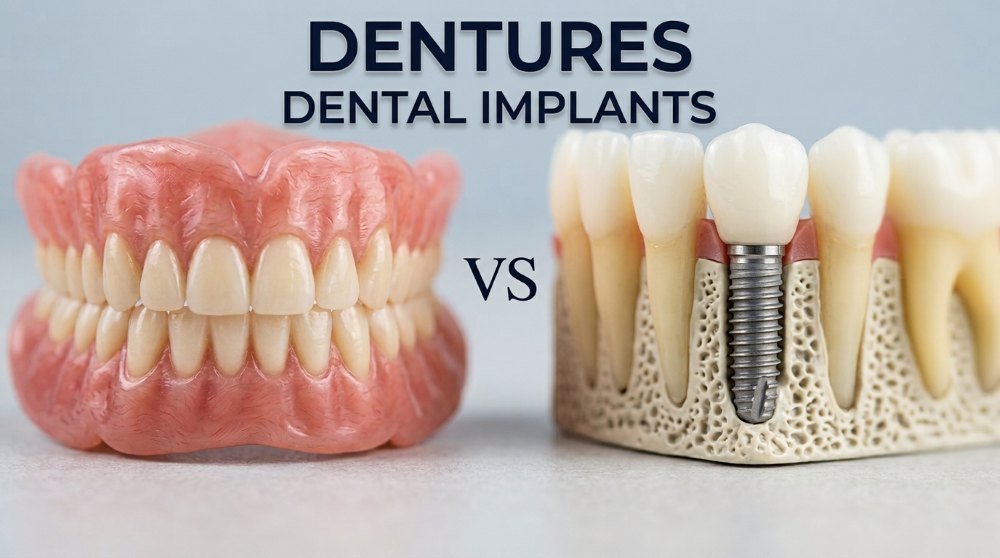
Dentures vs Dental Implants: Pros, Cons, and Costs Compared
Table of Contents
A full set of conventional dentures costs $1,000 to $3,000 per arch. A single dental implant costs $3,000 to $6,500 per tooth. An implant-supported denture, which sits between the two, costs $5,000 to $15,000 per arch. Cost is only part of the decision, though: comfort, bone health, and how much upkeep you’re willing to take on all factor in too.
Key Takeaways
- Conventional full dentures cost $1,000 to $3,000 per arch; partial dentures cost $600 to $2,000.
- Implant-supported dentures cost $5,000 to $15,000 per arch, and typically include the implants themselves.
- A single dental implant, for one missing tooth, costs $3,000 to $6,500.
- The Canadian Dental Care Plan covers complete and partial dentures but does not cover dental implants at any income level.
- Dentures rest on the gum and jawbone; implants integrate with the bone directly, which changes how each affects the jaw over time.
- The right choice depends on how many teeth are missing, bone health, budget, and how much daily maintenance you want to deal with.
What’s the Difference Between Dentures and Dental Implants?
Dentures are removable appliances that replace some or all of your teeth. A complete (full) denture replaces an entire arch; a partial denture fills in gaps while your remaining natural teeth stay in place. Both rest on the gums and are taken out for cleaning.
Dental implants are titanium posts placed into the jawbone to act as artificial tooth roots. A single implant supports one crown. Multiple implants can also support a bridge or, for someone missing most or all of their teeth, an implant-supported denture: a removable denture that snaps onto two or more implants for far more stability than a conventional denture resting on the gum alone. Some patients land on a fixed, non-removable full-arch option instead, which costs more but functions closer to natural teeth.
Cost Comparison: Dentures vs Dental Implants
|
Option |
What It Replaces |
Typical Cost (CAD) |
|
Partial denture |
Some teeth, removable |
$600 to $2,000 |
|
Complete denture |
Full arch, removable |
$1,000 to $3,000 per arch |
|
Implant-supported denture |
Full arch, removable, anchored to implants |
$5,000 to $15,000 per arch |
|
Single tooth implant |
One missing tooth, fixed |
$3,000 to $6,500 |
|
Fixed full-arch implants |
Full arch, fixed, non-removable |
$15,000 to $30,000+ per arch |
These are starting points, not quotes. Bone grafting, extractions, and imaging can add to any of these totals, and a consultation is the only way to get a number specific to your mouth.
Pros and Cons of Dentures
Pros
- Lower upfront cost than any implant-based option.
- No surgery required for conventional dentures.
- Often the fastest path to a full set of replacement teeth.
- Covered under the Canadian Dental Care Plan for eligible patients.
Cons
- Can feel loose, especially with lower dentures, and may need adhesive.
- Chewing efficiency is generally lower than with natural teeth or implants.
- Requires relines or replacement over time as the jawbone and gums change shape.
- The jawbone under a denture tends to shrink gradually, since the denture rests on top of it rather than replacing a tooth root.
Pros and Cons of Dental Implants
Pros
- Function and feel closer to natural teeth than a removable denture.
- Don’t rely on adjacent teeth for support, unlike a bridge.
- Help maintain jawbone volume, since the implant post takes the place of a natural tooth root.
- Long-term research on titanium implants generally reports survival rates above 90% after 20 years.
Cons
- Higher upfront cost, especially for a full arch.
- Requires adequate bone density and generally good overall health.
- Involves surgery and a healing period that can run several months.
- Not covered by the Canadian Dental Care Plan, and inconsistently covered by private insurance.
Bone Health: The Difference That Doesn’t Show Up on a Price Tag
This is the part that’s easy to miss when comparing dentures and implants on cost alone. A denture sits on the gum and the ridge of jawbone underneath it, but it doesn’t replace the root of the tooth that used to be there. Without that root stimulating the bone, the jawbone under a denture-bearing ridge tends to resorb, or shrink, gradually over years, which is part of why dentures often need relining or replacing and why a denture that fit well at first can loosen over time.
An implant is anchored directly into the bone, similar to a natural tooth root, which is one reason implant-supported solutions are generally associated with better bone preservation over time. Research on this varies somewhat by implant design and number, but the general pattern holds across the literature on residual ridge resorption. This doesn’t mean bone loss stops entirely with implants, just that the mechanism driving it is different.
Maintenance and Daily Care
Dentures need to be removed and cleaned daily, generally left out of the mouth overnight, and brought in periodically for adjustments or relines as the fit changes. Implants and implant-supported dentures are cared for more like natural teeth: brushing, flossing (or specific tools for implant-supported dentures), and regular hygiene visits, though the attachments on an implant-supported denture may need occasional replacement.
Which Is Better: Dentures or Implants?
There isn’t a single right answer here; it depends on a handful of factors specific to you.
- Budget. Dentures cost less upfront. If cost is the deciding factor and you’re eligible for the CDCP, that coverage applies to dentures, not implants.
- Bone health. Implants need enough healthy jawbone to anchor into. Years of bone loss from long-term denture wear or missing teeth can mean a bone graft is needed first, which adds cost and time.
- Number of missing teeth. A single missing tooth is usually a more straightforward case for an implant than for a partial denture. Full-arch tooth loss opens up the widest range of options, from a complete denture to an implant-supported denture to a fixed full-arch solution.
- Overall health and healing ability. Implant placement is a surgical procedure, so conditions that affect healing, along with smoking, can affect candidacy and outcomes.
- How much daily maintenance you want. Some patients prefer the lower day-to-day fuss of implants once healed; others are comfortable with a denture routine.
A consultation, with an exam and imaging, is what actually answers this question for your mouth. Nobody can tell you which option is right from a blog post alone.
Does Insurance or the CDCP Cover Dentures or Implants?
The Canadian Dental Care Plan covers complete and partial removable dentures for eligible patients, subject to the plan’s fees and any applicable co-pay. Dental implants, including implant-supported dentures, are excluded from CDCP coverage entirely, regardless of income tier.
Private insurance is more mixed. Many plans cover a portion of conventional dentures under prosthodontic or major restorative benefits. Implants are covered far less consistently, and some plans exclude them outright even when they cover dentures or bridges under the same category. Confirm your specific plan’s coverage with your insurer before committing to either option.
Financing Options
Because implant-based options in particular are a significant out-of-pocket expense for most patients, financing is worth asking about.
- In-office payment plans, where the total is split into monthly instalments, vary by practice.
- LendCare offers financing for patients without insurance, with payments spread over a set term.
- Health Spending Accounts through an employer’s benefits plan may cover part of either option, depending on how the plan is structured.
Frequently Asked Questions
Which is better, dentures or implants?
Neither is universally better; it depends on your bone health, budget, how many teeth are missing, and how much daily maintenance you’re comfortable with. Dentures cost less and involve no surgery. Implants function closer to natural teeth and help preserve jawbone, but cost more and require adequate bone and healing capacity. A consultation is the only way to know which fits your situation.
What are implant-supported dentures, and how are they different from regular dentures?
An implant-supported denture is a removable denture that snaps onto two or more implants placed in the jawbone, rather than resting on the gum alone. This gives it far more stability than a conventional denture, closer to a fixed tooth, while still being removable for cleaning. It costs more than a conventional denture, typically $5,000 to $15,000 per arch, but less than a fixed full-arch implant solution.
Can I switch from dentures to implants later?
Often, yes, though it depends on how much bone remains at that point. Long-term denture wear can lead to bone loss that makes implants harder to place without a bone graft first. If you think you might want implants eventually, it’s worth raising that at a consultation before committing to dentures alone, so bone preservation can factor into the plan.
Do implants really last longer than dentures?
Generally, yes, though both require maintenance over time. Dentures typically need relining or replacement every five to ten years as the jaw changes shape. Implants, when the surrounding bone and gum stay healthy, can last decades, with the crown on top sometimes needing replacement sooner than the implant post itself due to normal wear.
Is a full set of implants cheaper than an implant-supported denture?
Usually not. A fixed full-arch implant solution, often using four to six implants per arch, generally costs more than an implant-supported removable denture, since it involves more implants and a more complex, non-removable prosthesis. An implant-supported denture is often the middle-cost option between conventional dentures and a full fixed-implant arch.
The Bottom Line
Dentures cost less upfront and involve no surgery, but they rest on the gum rather than replacing the tooth root, which affects both fit over time and the jawbone underneath. Implants, including implant-supported dentures, cost more and require adequate bone and healing capacity, but function closer to natural teeth and help preserve bone volume. Neither option is automatically better; the right one depends on your mouth, your budget, and what the CDCP or your insurance actually covers.
We Smile Dentistry offers consultations where a dentist can look at your bone health and remaining teeth, walk through both paths, and help you weigh what fits your situation. Reach out to our team to book a consultation and get a clearer picture of what’s realistic for your smile.
This content is for informational purposes only and is not a substitute for professional dental advice, diagnosis, or treatment. For personalized care, please book a consultation with Dr. Spagnuolo at We Smile Dentistry by calling 519-661-0042 or visiting wesmiledentistry.ca/contact.