

That Small Black Point on Your Tooth: Causes, Treatments, and When to Act
Table of Contents
- What Is That Small Black Point on Your Tooth, Really?
- How to Tell the Difference Between a Cavity and a Stain at Home
- How to Treat Small Black Points on Your Teeth
- Preventing Black Points on Your Teeth Before They Start
- Things to Know
- Frequently Asked Questions
- The Bottom Line on That Small Black Point on Your Tooth
A small black point on your tooth is most commonly either a surface stain or an early sign of tooth decay. While not every dark spot signals a cavity, some do require prompt dental attention to prevent deeper damage.
Key Takeaways
- A black spot on your tooth may be caused by staining, tartar buildup, fluorosis, or tooth decay, so a dental exam is the best way to determine the cause.
- Cavities tend to appear as a single dark point on one tooth, while stains usually spread across multiple teeth.
- If a dark spot feels rough, sticky, or is growing in size, treat it as decay until proven otherwise.
- Early-stage decay can often be reversed with fluoride or remineralization treatments, avoiding the need for a filling.
- Root canal treatment may be necessary when decay reaches and damages the inner pulp of the tooth, but early diagnosis and treatment can often prevent decay from progressing to this stage.
- Prevention involves more than brushing: daily flossing, limiting acidic foods, and regular professional cleanings all play a role.
What Is That Small Black Point on Your Tooth, Really?
Not every dark mark on your enamel means the same thing. The colour alone does not tell the whole story. What causes a black point on your tooth can range from your morning coffee habit to a bacterial infection silently eating through your enamel. Understanding the difference between these causes is the first step toward making the right decision about your dental health.
Tooth Decay: The Most Concerning Cause
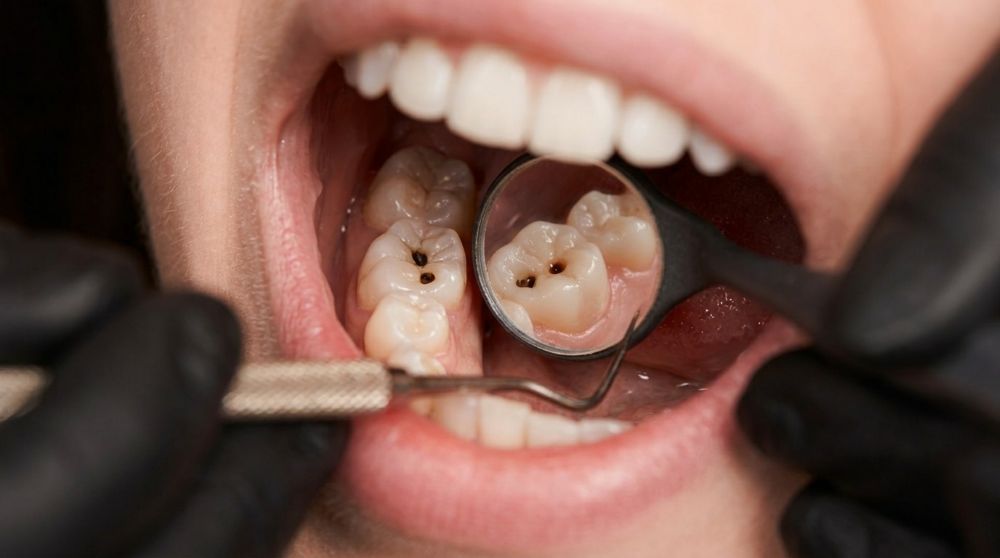
Tooth decay begins when bacteria in your mouth feed on sugars and produce acids. Those acids slowly weaken your enamel in a process called demineralisation. At first, you might notice a white or chalky patch, which is an early warning sign most people miss entirely. As the breakdown progresses, the affected area darkens. Once the decay reaches the dentine layer beneath the enamel, that small spot turns noticeably black.
According to Health Canada, tooth decay remains one of the most common chronic diseases affecting Canadians of all ages. Roughly 38% of children in Canada have experienced cavities, and many cases go undetected until pain begins, which is far too late for the simplest treatments.
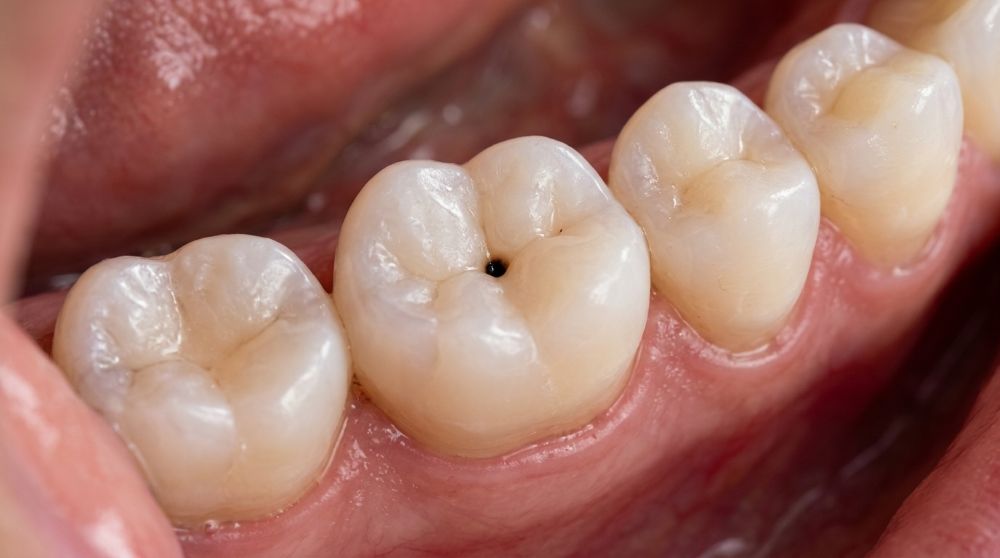
One key detail: a single dark spot on one isolated tooth is far more likely to be a cavity than a stain. Stains tend to spread across several teeth because they result from repeated contact with pigmented substances. A lone black point deserves closer attention.
Fluorosis: When Too Much Fluoride Leaves a Mark
Dental fluorosis occurs when a child ingests too much fluoride during the years when permanent teeth are forming, typically before age eight. Most cases of fluorosis are mild and appear as faint white streaks that go largely unnoticed. In more severe cases, though, the enamel develops brown or black pitting that can look similar to decay but has a very different origin.
In Canada, fluorosis can occur when children regularly swallow fluoride toothpaste, consume water with elevated natural fluoride levels, or use fluoride supplements without professional guidance. If you notice dark spots on a child’s newly erupted permanent teeth alongside other white markings, fluorosis may be the cause rather than decay.
Additional Causes Behind Black Points on Your Teeth
Beyond decay and fluorosis, several other factors can produce that small dark mark:
- Surface staining: Coffee, tea, red wine, dark berries, and soy sauce all contain pigments called chromogens that bind to enamel. Over time, these deposits build up and darken, particularly in the grooves of your molars.
- Tobacco and smoking: Tar and nicotine from cigarettes or chewing tobacco leave stubborn dark stains that penetrate beyond the surface layer of enamel, making them resistant to regular brushing.
- Tartar buildup: Plaque that is not removed through brushing and flossing hardens into tartar within 24 to 72 hours. Tartar starts out yellowish, but when it absorbs pigments from food or tobacco, it can turn dark brown or black. Only a dental professional can remove it.
- Old dental work: Silver amalgam fillings can leach metal ions into surrounding tooth structure over many years, causing a greyish or black shadow beneath the enamel near the filling edge.
- Medications: Certain antibiotics, particularly tetracyclines taken during childhood, can cause intrinsic tooth discolouration that appears as dark banding or spots within the tooth itself.

How to Tell the Difference Between a Cavity and a Stain at Home
You cannot definitively diagnose a cavity at home, but you can gather useful clues before your appointment. Here is a practical breakdown to help you assess what you are seeing:
| Feature | More Likely a Stain | More Likely a Cavity |
| Location | Spread across multiple teeth | Isolated to one tooth or groove |
| Texture | Smooth to the touch | Rough, sticky, or pitted |
| Growth | Stable over months | Noticeably larger over weeks |
| Pain or sensitivity | Absent | Sensitivity to cold, sweet, or pressure |
| Shape | Flat, diffuse discolouration | Distinct dark point or hole |
| Lifestyle link | Heavy coffee/tea/tobacco use | No obvious dietary cause |
Run your tongue gently over the spot. A stain typically feels smooth. A cavity often has a slightly rough or sticky texture because the enamel structure has broken down. If pressing gently on the area with your fingernail causes discomfort, that is a significant warning sign.
Also pay attention to sensitivity. If the spot aches when you drink something cold, sweet, or hot, or if you feel a brief sharp pain when biting down, the enamel has very likely been compromised.
How to Treat Small Black Points on Your Teeth
Treatment depends entirely on the cause. A dentist at a clinic like We Smile Dentistry in London, ON will examine the spot visually, probe it with a dental instrument, and likely take X-rays to determine how deep any decay has progressed before recommending a course of action.
1. Fluoride or Remineralisation Treatments
If decay is caught in its earliest stage, before it has fully broken through the enamel, there is a real chance of reversing it without drilling. Fluoride varnishes applied by your dentist strengthen weakened enamel by reintroducing minerals. Calcium phosphate products, such as Tooth Mousse, work similarly. These treatments are most effective when the black point is still superficial and the dentine has not yet been affected.
This approach is only viable for very early decay. Once the spot has progressed into the dentine layer, remineralisation alone is no longer sufficient.
2. Composite Resin Fillings
For most cavities that have progressed beyond the earliest stage, a tooth-coloured composite resin filling is the standard treatment. The dentist removes the decayed material, cleans the area, and bonds the resin directly to the tooth. Modern composites are matched to your natural tooth shade, making them virtually invisible.
In Canada, the cost of a small composite filling typically ranges from C$150 to C$300 per tooth, depending on size and location. Many provincial dental plans and employer-sponsored benefits cover a portion of this cost. The Canadian Dental Care Plan (CDCP), launched in 2024, also provides coverage for eligible Canadians who do not have private dental insurance.
If the black spot turns out to be a stain rather than decay, a professional polish or teeth whitening treatment may be all that is needed, and the cost is considerably lower.
3. Root Canal Treatment
A root canal becomes necessary when decay has passed through the enamel and dentine and reached the pulp, which is the soft inner tissue containing nerves and blood vessels. At this stage, you will almost certainly be experiencing persistent tooth pain, swelling, or prolonged sensitivity rather than just a visible spot.
During a root canal, the infected pulp is removed, the canals are cleaned and shaped, and the tooth is sealed, usually with a crown placed on top. Root canals have an undeserved reputation for being painful. In practice, modern anaesthesia makes the procedure no more uncomfortable than getting a filling. The pain you feel before treatment is nearly always worse than the procedure itself.
Preventing Black Points on Your Teeth Before They Start
Prevention is always less expensive, less time-consuming, and less stressful than treatment. A comprehensive prevention strategy goes well beyond just brushing.
Brush Effectively Not Just Frequently
The standard recommendation is to brush at least twice a day using a fluoride toothpaste. Brushing two to three times a day is ideal, particularly after meals high in sugar or acid. However, technique matters as much as frequency. Use a soft-bristled brush at a 45-degree angle to the gumline and use gentle circular or short back-and-forth strokes. Aggressive scrubbing can wear down enamel over time.
Electric toothbrushes have been shown in clinical research to remove more plaque than manual brushes, which is worth considering if you are prone to buildup.
The Role of Flossing, Diet, and Professional Cleanings
Brushing alone misses the spaces between teeth, which is where many cavities start. Daily flossing removes the plaque and food debris that your brush simply cannot reach.
Diet plays a significant role as well. Limit sugary and acidic foods and drinks, including fruit juices, which many Canadians consume daily without realising how erosive they can be. Rinse your mouth with water after consuming acidic foods if brushing right away is not practical.
Professional cleanings every six months remove hardened tartar that home care cannot address. Your dentist or hygienist can also spot early changes in your enamel before they progress to a visible black point.
Early Warning Signs to Watch for Between Appointments
Do not wait for pain to take action. Other early indicators that something may be developing include:
- A white or chalky patch on the enamel surface
- Increased sensitivity to cold drinks or sweet foods
- A rough feeling in a specific spot when you run your tongue across a tooth
- Any discolouration that appears and grows over a few weeks
Things to Know
- A single dark spot on one tooth is more likely a cavity than a stain. Stains typically affect multiple teeth.
- Fluorosis-related spots form during childhood tooth development and cannot be caused by fluoride exposure in adulthood.
- Tartar can only be removed by a dental professional. No amount of brushing will dislodge it once it has hardened.
- The Canadian Dental Care Plan (CDCP) may cover part of your treatment costs if you do not have private dental insurance.
- Composite fillings are not permanent and typically last 7 to 10 years before needing replacement.
- Leaving a cavity untreated does not mean it stays small. Decay progresses continuously until treated, and what starts as a C$200 filling can become a C$1,500 root canal and crown.
Frequently Asked Questions
Can a small black point on my tooth go away on its own?
A stain can fade with professional cleaning, but a cavity will not heal without dental treatment.
If the black point is surface discolouration from coffee, tea, or tobacco, a professional polish may remove it. However, if the spot is early-stage decay, it requires either remineralisation therapy from your dentist or a filling. Decay does not reverse itself once it reaches the dentine layer.
Is a black spot on my tooth always a cavity?
No, but it always warrants professional evaluation to rule out decay.
Many black spots are harmless stains, tartar, or fluorosis markings. However, because the visual appearance of a stain and an early cavity can be nearly identical, a dentist needs to probe and X-ray the area to give you a definitive answer.
How quickly can a small black point turn into a serious cavity?
The timeline varies, but untreated decay can reach the pulp within months to a few years depending on diet, oral hygiene, and saliva composition.
Some people progress slowly; others have naturally more acidic saliva that accelerates breakdown. This is why prompt diagnosis matters far more than waiting to see if the spot grows.
Does a black spot on a tooth always cause pain?
Not at first. Early decay often causes no pain at all, which is why many people delay seeing a dentist.
Pain typically begins when the decay has reached the dentine or pulp, which is a significantly more advanced stage. A painless black spot is not a reassuring sign that everything is fine.
What does treatment cost in Canada for a black spot on a tooth?
Costs range from C$0 for a covered cleaning to C$2,000 or more for a root canal and crown, depending on severity and your insurance coverage.
A professional cleaning may address surface stains. A small filling typically costs C$150 to C$300. Root canals and crowns combined can reach C$1,500 to C$2,500 in most Canadian cities. Check whether the Canadian Dental Care Plan or your employer benefits apply to your situation.
The Bottom Line on That Small Black Point on Your Tooth
That small dark mark on your enamel is telling you something. It may be harmless, or it may be the beginning of a problem that will only grow more complex and costly the longer it goes unaddressed. Either way, you deserve a clear answer from a professional rather than months of uncertainty.
If you are in London, ON, the team at We Smile Dentistry (81 Oxford St W) can assess that spot, identify its cause, and walk you through your options with no pressure. Book an appointment at the first sign of concern. What feels minor today is almost always easier, faster, and less expensive to treat than what it becomes tomorrow.